

 English
 Български
 Hrvatski
 Čeština
 Dansk
Dansk Nederlands
 Eesti
Eesti Suomi
Suomi Français
 Deutsch
 Ελληνικά
 Magyar
 Gaeilge
 Italiano
 Latviešu
 Malti
Malti Polski
 Português
 Română
 Русский
 Slovenčina
 Slovenščina
 Español
 Svenska
A "no-log VPN" is one of the most common phrases in online privacy — and one of the most misunderstood. This guide explains, in plain language, what it means, what it does not mean, and how to judge whether a provider's claim is honest.
What "no logs" actually means
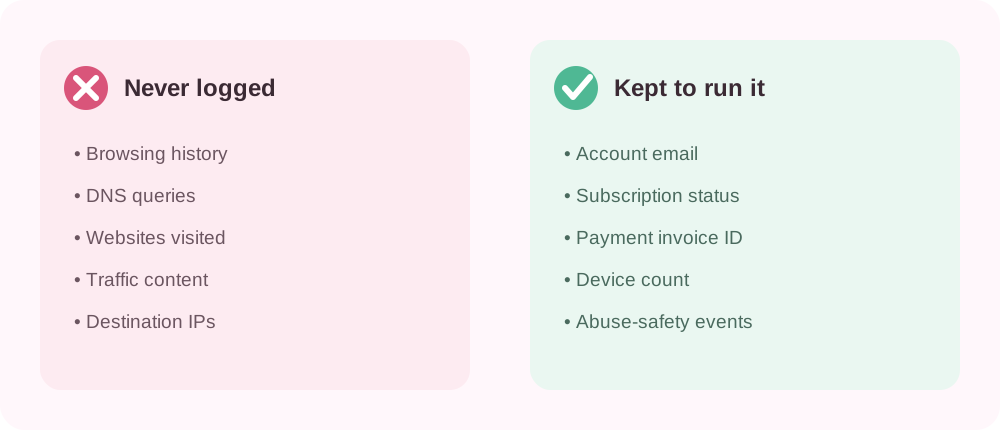
When people say no-log VPN, they usually mean the provider does not keep records of your online activity: the websites you visit, the apps you use, your DNS lookups, or the content of your traffic. Your connection is encrypted between your device and the VPN server, so your local network and internet provider cannot see what you are doing either.
That is the important part: a no-log VPN removes your browsing history from the equation. If those records do not exist, they cannot be leaked in a breach, sold to advertisers, or handed over on request.
What every provider still needs
Here is the honest nuance most marketing skips: no VPN keeps nothing at all. To run a subscription service, a provider needs a small amount of data:
- An account identifier, usually an email address.
- Your subscription status and expiry date.
- Payment records for the invoices you create.
VPN servers also handle basic connection metadata as part of normal networking — for example, a source IP at the moment you connect — which helps with abuse protection. That is not a browsing history, and a well-designed service does not use it to profile you. The goal is to keep only what is necessary to operate and protect the service.
At Nekoway, this line is described openly in our No-Logs Policy and Privacy Policy, so you can read exactly what is and is not kept.
How to judge a no-log claim
Marketing pages love the phrase "no logs." Here is how to look past it:
- Read the actual policy. A trustworthy provider explains what it does and does not store, not just a slogan.
- Be sceptical of absolutes. Claims like "100% anonymous" are usually overstated. Pseudonymous is realistic; perfectly anonymous is not.
- Check how payments work. Card payments tie your identity to your account. Paying with cryptocurrency avoids sharing card details — see our guide to a crypto VPN.
- Ask about audits carefully. An independent audit is a plus, but many providers — including Nekoway, for now — have not completed one. Do not assume "no-logs" means "audited."
Does no-logs make you invisible?
No — and any provider that says so is overselling. A no-log VPN is a strong privacy layer, but your habits still matter. Log into an account and the site knows it is you. Modern encryption protects the connection, not your choices. Think of it as removing one large, unnecessary source of risk — your browsing history — rather than a magic cloak.
The practical takeaway
A good no-log VPN does not record your activity or DNS queries, keeps only the minimal account and payment data needed to run your subscription, explains its practices in a policy you can actually read, and does not make impossible promises.
If you want a privacy-first VPN with fast European routes and crypto payments, see Nekoway's plans or download the app to get started.
Frequently asked questions
Does a no-log VPN keep my email? Yes — an account email or another identifier is normally needed to manage your subscription. That is account data, not a browsing log.
Is a free no-log VPN trustworthy? Be cautious. Running servers costs money; some free VPNs monetise by logging and selling data. Read the policy and understand how the service is funded.
Can a no-log VPN still see my IP? A server handles your connection, so it briefly sees a connecting IP as part of networking. A no-log design means it is not turned into a stored history of your activity.